
But how exactly is AI transforming search habits? And how should you adjust your SEO strategy accordingly? This article aims to answer these questions.
Artificial Intelligence in Everyday Life
We can approach the topic of search habits from two angles.
1. ChatGPT
Since OpenAI released ChatGPT to the public, its popularity has been unwavering. While we initially marveled at its ability to write an official letter in two minutes, nowadays we’re sometimes relying on ChatGPT’s responses even over Google’s.
When someone has a particularly personalized question, it’s often easier to ask for the AI’s opinion on the matter than to type keywords into a search engine and hunt for that specific topic of interest.
I’ve noticed myself increasingly turning to ChatGPT in situations where I’m looking for answers to very specific questions.
2. Google Gemini és Google AI Overview
It’s no secret that Google is working full steam on integrating artificial intelligence into its search engine. While this function is currently available to a very limited audience in the USA and is still in its infancy, this won’t always be the case.
Additionally, Google AI Overview is already available, appearing on the search results page and providing an AI-generated summary of the most important information on the searched topic.
How AI is Transforming Our Search Habits
1. Search Phrases
The era of short, concise keywords has long passed. After keyword research and when preparing content strategies for my clients, I always recommend prioritizing so-called long-tail search phrases over single-word keywords. This allows for much more precise targeting, ensuring content appears for those searching within that specific topic segment.
With the rise of artificial intelligence, this will become even more significant. AI is better able to understand user intent and interpret natural language. This means that searches will likely move in a direction where users initiate searches the way they speak.
For example:
“How can I increase my website’s visibility with SEO if I’m working with a small budget?” instead of “SEO tips”
Or:
“What factors should I consider when looking for an online photography course for beginners interested in nature photography?” instead of “online photography course for beginners”
2. Rise of Voice-Based Search
With AI development, voice-based search is becoming increasingly popular. Voice assistants like Siri, Alexa, or Google Assistant allow us to perform searches simply by speaking, without using our hands. This trend is significantly changing our search habits.
According to a survey, more than 70% of users prefer voice-based search over typing. This isn’t just a matter of convenience – voice-based searches are generally longer and more detailed, potentially resulting in more accurate results.
3. Visual and Multimodal Search
With the advancement of artificial intelligence, search is no longer limited to just text. Visual search allows us to use images as search inputs. For example, if we see an interesting plant, we can simply take a photo and search for information based on the image.
In the future, this technology is expected to develop further, and multimodal searches will emerge, where we can use text, images, and sound simultaneously for searching. This could open up new dimensions in our search habits.
4. Personalized Search Experience
It’s well-known that search engines collect data about users during searches, which is taken into account in subsequent searches. This includes the user’s search history, geographical location, and device usage.
The development of AI and machine learning enables even more sophisticated and deeper personalization during searches.
Artificial intelligence can recognize more complex patterns in user behavior and apply them faster and more accurately. Thus, search engines better understand context and user intent, not just relying on immediate search history.
This can greatly influence the final search results.
5. Prediktive Search
Artificial intelligence can predict what we might need even before we start searching. This predictive search is already present in some form (think of Google’s auto-complete suggestions), but it will become even more sophisticated in the future.
It’s conceivable that search engines will proactively recommend content and information based on our daily routines, location, and other contextual information, even before we realize we need them.
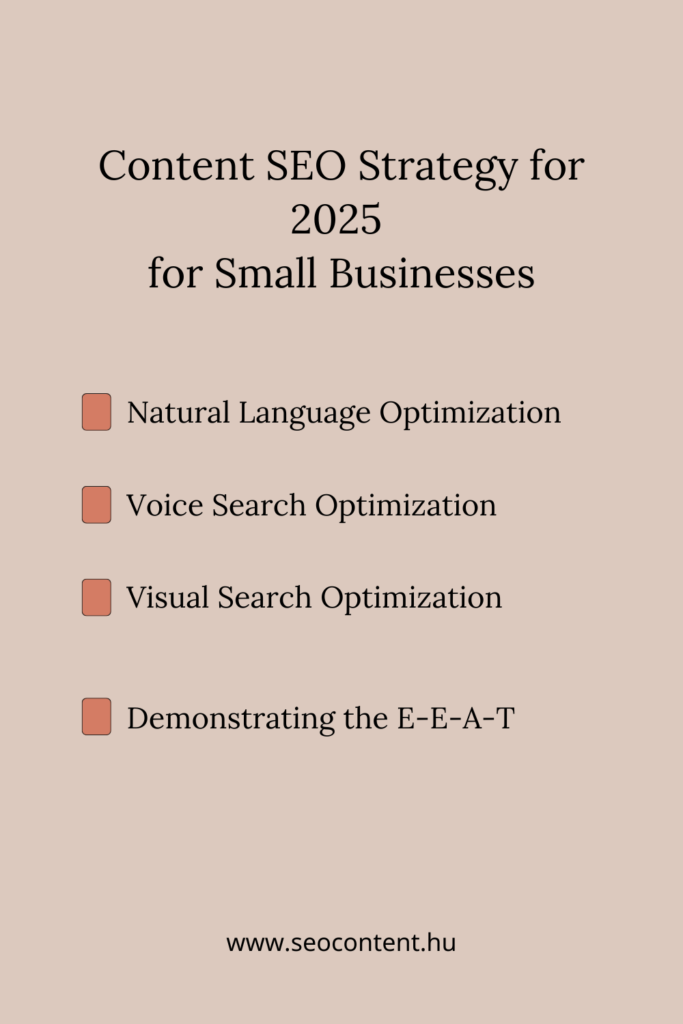
SEO Strategy 2025 for Small Businesses
Here are some tips that you, as a small business owner, can immediately incorporate into optimizing your content:
1. Natural Language Optimization
While it’s been important before, it will be indispensable in 2025: formulate your content as if your potential customer were sitting in front of you, having a conversation. No need for flowery sentences or jargon, just strive to be authentic.
Extra tips:
- Create a FAQ page where you answer full-sentence questions (either a separate page within your website or at the end of blog posts)
- Use longer keywords in your content that are closer to spoken language
2. Optimizing for Voice-Based Search
As not as complex as it sounds, it’s actually quite simple.
Optimize your content for questions starting with “Who”, “What”, “Where”, “When”, “Why”, “How”.
3. Optimizing for Visual Search
Provide detailed alt text for images that describe what the image depicts. (Of course, the description should also contain the primary keyword.)
- Use relevant, high-quality images of your products or services.
4. Demonstrating the E-E-A-T
The E-E-A-T guide stands for “Expertise, Experience, Authoritativeness, and Trust”. It’s an important part of Google’s search algorithm that evaluates the quality and credibility of websites. With the rise of AI, credibility will play an even bigger role.
- Highlight your professional experience, show how you’ve solved others’ problems before (e.g., through case studies)
- Show that reliable professionals stand behind your products/services
- In the future, brand building will be indispensable for entrepreneurs due to the need for reliability and credibility
- Make the accuracy of information on your website easily verifiable
- Make contact easy
- Frequently update your website content
Some extra tips
- Group your content according to user intent (e.g., categorize frequently occurring topics and make them findable in one place)
- Create content according to seasonal or expected trends – preparing for predictive search
- Optimize all your content for mobile
- Structure your content so that it’s easily extractable
- Create comprehensive content on a topic, covering several of its aspects
Summary
AI is undoubtedly transforming search habits. From keyword searches to natural language questions, from text input to voice and image-based searches, from generic results to personalized findings – AI is enhancing and refining the search experience in every area.
These changes not only benefit users but also open up new opportunities for businesses to reach their target audience.
As AI continues to evolve, it will be exciting to see how search habits further develop.
I hope the tips provided in this article will help you adequately prepare for content creation in 2025.
However, if you need help, feel free to reach out!
Picture:
https://www.pexels.com/search/freelancer%20marketer/
Sources:
https://searchengineland.com/google-e-e-a-t-guide-seo-394191